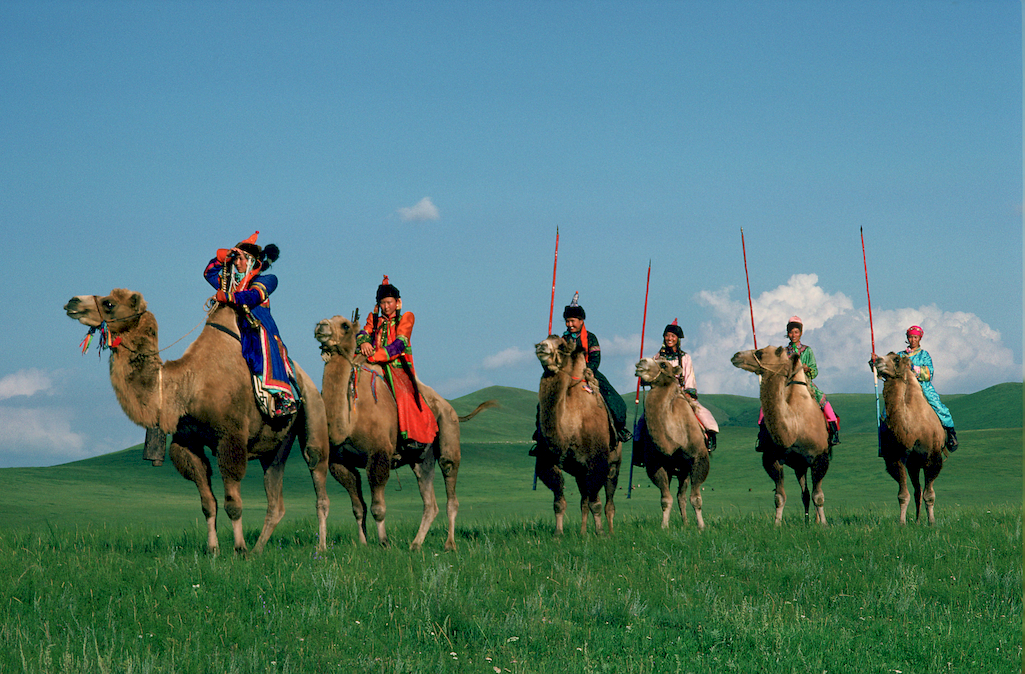
In 2025, Queer East expanded its outreach to Central Asia with an event guest-curated by Misha Zakharov, entitled Parallel Voices: Queering (Post-)Soviet Central Asia. The programme featured a rare screening of Uzbek filmmaker Rustam Khamdamov’s queer-coded musical extravaganza Vocal Parallels, set in Kazakhstan. This year, the festival turns its attention to Northeast Asia with a screening of German filmmaker Ulrike Ottinger’s Johanna d’Arc of Mongolia — a resplendent lesbian epic set in the Mongolian steppe. Tickets for the screening on 17 May at the ICA, which will be preceded by a conversation with Buryat artist Margo Galandina, are available here.
In conjunction with this screening, Misha Zakharov interviewed queer researchers and advocates Dorjjantsan “Jack” Ganbaatar and Erdeneburen “Gonto” Dorjpurev, who have recently co-authored an article about their experience of working on the country’s first-ever queer film festival, Beyond the Blue Sky. In their generous responses, Jack spoke about the queer scene, legislation and historical context of Mongolia, while Gonto commented on their situated experience of watching Johanna d’Arc of Mongolia, a film that has previously been discussed primarily by European critics and theorists
MISHA ZAKHAROV: Could you briefly introduce yourself and speak about your experience of LGBTQI+ advocacy in Mongolia?
DORJJANTSAN “JACK” GANBAATAR: My name is Jack, and I’m from Mongolia. I am an LGBTQI+ rights activist and a public health researcher. Most of my work focuses on healthcare access in Mongolia, but I’ve also been involved in frontline queer rights activism for the past decade. Currently, I am based in Melbourne, Australia, where I am doing my PhD. My thesis focuses on LGBTQI+ healthcare access in Mongolia.
Previously, I worked at the first — and, until recently, the only — LGBT Centre in Mongolia, which was officially established in 2009, although we began the registration process in 2006. The state authorities did not recognise or register us initially, and we had to fight for three years before we were officially registered in 2009. So, the first LGBT Centre in Mongolia was registered in 2009, making it quite a young movement, but also a very vibrant and thriving one, I would say.
I listened to one of your webinars, and in it you mentioned that there has been progress, at least in terms of legislation. But how are things in terms of everyday or casual interactions? Is there still casual homophobia in Mongolian society?
I think, in general, Mongolia is one of those Asian countries that is less discussed in a Western context, particularly in terms of queer progress and the queer movement. As I mentioned, the first LGBT Centre was established relatively late, so the movement is still quite young. However, I would like to give credit to the pioneers of the LGBT movement and The LGBT Centre, where I worked for many years. I believe the advocates and pioneers were very smart and strategic from the beginning. That is why we have made significant progress in terms of legislation.
For example, regarding protection against hate crimes, we have made considerable advances. Mongolia became one of the first countries in the region to explicitly protect LGBT people in its criminal code in 2015, which came into force in 2017. This placed us among the leading countries in the region in terms of legal protection against violence and discrimination based on sexual orientation and gender identity. Discrimination is now officially a crime in Mongolia. If someone discriminates against another person on these grounds, it is punishable by law, with potential imprisonment of up to a couple of years.
However, this is largely on paper. In reality, there is a huge gap between legislation and implementation. Until recently, there had not even been a case brought to court using this law. This is exacerbated by the fact that many queer individuals do not feel able to access these legal protections. They are often afraid to report incidents. Without reports, there can be no cases. This situation is further compounded by discrimination, stigma, and negative attitudes among public servants, including the police and others working within the system.
So it’s a very complex issue, and it reflects the broader societal stigma towards queer people. To fully understand the daily struggles and experiences of queer individuals, we must also consider Mongolia’s history. For many years, Mongolia was a socialist state. Although it was never formally part of the Soviet Union, it functioned as a satellite state from 1920 until 1990. For seven decades, it was a communist state and is often considered one of the longest-lasting socialist systems. After the collapse of the Soviet Union, Mongolia transitioned peacefully — and that’s very important — from a socialist to a democratic state. This transition opened the country to broader human rights developments and created space to begin exploring and advancing queer rights as well.
And on a related note, could you speak a bit about the intersection between colonialism and homophobia in Mongolia? From what I read in your article co-authored with Gonto, I understand that Mongolians often use English and Russian terms when referring to queerness. As a result, queerness can be perceived as something imported or foreign. At the same time, there seems to be a movement towards indigeneity — towards decolonising Mongolia and returning to shamanism and historical roots. How do these dynamics interact or clash?
When it comes to Mongolia, it’s quite complex. Mongolia was under the Manchu Empire of the Qing Dynasty for almost 300 years, and later became a socialist state and a satellite of the Soviet Union for seven decades. In that sense, there are elements of what could be considered colonisation — from both the Qing Dynasty and the Soviet Union. But scholars and historians often argue that this differs from colonisation in the Western sense. Mongolia was not colonised in the same way as many other parts of the world; the nature and degree of control were different.
When it comes to queerness, socialism has had a profound impact on the contemporary landscape. Mongolia has traditionally been a nomadic culture, and even today it remains one of the last predominantly nomadic societies. One consequence of this is that written history has been relatively limited, with much of the cultural record preserved through oral traditions.
Furthermore, during the socialist period beginning in the 1920s, much of Mongolia’s cultural and historical record was actively suppressed or destroyed. There were restrictions on engaging with pre-socialist history, including references to Genghis Khan, as well as religious and cultural practices such as shamanism. These were seen as incompatible with socialist ideology. As a result, what limited historical documentation existed was further diminished. This has left contemporary Mongolia with very little archival material that might connect past cultural practices to expressions of queerness.
Until relatively recently, there were also no widely used indigenous terms to describe concepts related to queerness, such as sexual orientation or gender diversity. Following democratisation in the 1990s, Mongolia — like many other countries — had to respond to the HIV/AIDS crisis. This became one of the primary entry points through which queer issues were introduced into public discourse, largely from a public health perspective. This is why much of the terminology used in Mongolia today is borrowed or transliterated from English and Russian.
There are some historical terms that suggest the existence of diverse gender and sexual identities in the past, but these were not widely used and did not survive into contemporary language in a meaningful way. This absence contributes to the perception that queerness is foreign, even though there may have been local expressions that were never fully documented or preserved.
Under socialist influence, homosexuality was at times classified as a mental disorder and was also criminalised. Some historians suggest that explicit criminalisation was removed relatively early, possibly in the 1960s, although forms of indirect criminalisation persisted in legal language. Following democratisation, these provisions were eventually removed, and homosexuality ceased to be part of the criminal code.
In the late 1990s and early 2000s, there were initial collective efforts to address HIV/AIDS, which led to some degree of community mobilisation. But these efforts were relatively short-lived. Although Mongolia transitioned to a democratic system, queer issues remained largely unaddressed until the mid-2000s. The establishment of The LGBT Centre in 2009 marked a significant turning point, although this came relatively late compared to other contexts.
You mentioned that there may have been some precedent for queerness in Mongolian history. I was wondering what those might be — whether there were any queer-coded figures, perhaps shamanistic figures, or individuals similar to what are known among Native Americans as Two-Spirit people?
Shamanism has been a central aspect of nomadic culture, in some ways comparable to the traditions of First Nations peoples in North America. Mongolia was predominantly a shamanistic society until the 17th century, when it came under the rule of the Manchu Empire of the Qing Dynasty. Around that same time, Buddhism was introduced and gradually became the dominant religion. As a result, shamanistic practices were largely suppressed, and Buddhism replaced much of the existing cultural framework. Mongolia remained predominantly Buddhist until the socialist period, and after democratisation in the 1990s, both Buddhism and shamanism experienced a revival.
Within shamanistic belief systems, some scholars suggest that gender and sexual diversity were more accepted. But we do not have clear historical figures or icons from that tradition that can be directly mobilised within contemporary queer culture. This is due to several factors, including the lack of written records in a historically nomadic society and the later suppression of cultural histories. While certain figures may have existed, they are not widely recognised or significant within today’s queer movement.
Another important factor is that Mongolians tend to have a strong sense of pride in their history, particularly in relation to figures such as Genghis Khan. Discussions of such historical figures are approached with a high level of respect and sensitivity. As someone involved in the queer movement, I would say that activists are often cautious when engaging with history. There is a concern about provoking negative reactions in a society where the majority still holds stigmatising views towards queer people. As a result, although activists can be quite radical in their advocacy, they also remain attentive to cultural context.
For example, some people speculate about the possibility of Genghis Khan having had relationships with men, based on accounts of close male companionship. But making such claims publicly in Mongolia would be extremely controversial and difficult. For this reason, the movement generally avoids linking major historical figures directly to queerness, as it can sometimes do more harm than good.
Yes, I can totally see how this is a complex issue — one cannot simply impose contemporary understandings of queerness onto historical contexts without careful consideration. Turning to your activism, could you speak about your work with Beyond the Blue Sky, the first Mongolian queer film festival, and about your and Gonto’s experience of documenting and analysing this work in an academic context?
The LGBT Centre was established with a clear aim to advance the movement through collective action. One of the most visible forms of collective power in queer activism is Pride, and we drew inspiration from movements in other countries. From the beginning, there was a desire to build something similar in Mongolia.
It took about a year to organise the first Pride Week, which took place in 2013. At that time, due to safety concerns, the event was held in a closed venue. The programme included artistic showcases, and a film screening was part of it. One of the films shown was Behind the Blue Sky (2009) by Sean Devaney and Brandt Miller, in which the protagonists’ identities were concealed. The event brought together community members, civil society organisations, and supportive institutions, marking an early stage of collective organising in Mongolia.
I became involved in 2014, during the second Pride. That year, we aimed to expand the event and make it more public. We organised what we called an Equality Walk, which took place in Sükhbaatar Square, the central public square in front of the government buildings. There were only about 15 participants — mostly staff from The LGBT Centre, along with a few young volunteers and allies. Despite its small size, it was a significant moment. We walked around the square, chanting slogans such as “LGBT rights are human rights”, and then continued to an art exhibition venue.
That year also marked the beginning of the Beyond the Blue Sky film festival as a more structured initiative. At the time, there were very few, if any, queer films produced by Mongolian filmmakers, so the festival relied on international content. We collaborated with embassies and cultural institutions to screen films from countries such as the United States, Germany, and Australia. This format continued for several years, and I was involved in organising the festival from 2014 to around 2019.
Later, my co-author Gonto took a leading role and introduced a significant shift in direction. Instead of focusing primarily on international films, the festival began to prioritise and support local queer filmmakers. This marked a transition towards becoming an international festival that centres Mongolian voices. The shift, which took place around 2019-20, had a transformative impact. It encouraged a new generation of queer filmmakers in Mongolia and reduced reliance on imported content. More importantly, it created a space for young queer people to express themselves artistically and to continue discussion. Since then, the festival has continued to grow. Since 2024, BTBS has expanded further and became an international festival with a short film competition. It now has both Mongolian and International sections, supporting Mongolian queer filmmakers while also allowing Mongolian audiences to watch international queer shorts on the big screen. This builds on the earlier shift towards centring Mongolian voices, while also creating more space for exchange with queer filmmakers and stories from other places.
And what is the festival’s regular venue? Is it a cinema or The LGBT Centre?
In terms of venues, we have experimented with different spaces. Initially, screenings were held at The LGBT Centre, and later in independent venues. In recent years, we have been able to rent larger cinemas. But this has not been easy. Even when we pay standard rental fees and attract audiences, there can be backlash. Sometimes venues withdraw their support at short notice due to pressure from conservative groups, including religious and family organisations. There have also been instances of disruptions. As a result, cinema owners can be hesitant to collaborate. Despite these challenges, we have managed to consistently hold screenings in larger cinema spaces, which is an important achievement for the festival.
I would now like to turn to the film we’re screening at Queer East this year, Johanna d’Arc of Mongolia (1989).
Ulrike Ottinger was among the first foreign filmmakers permitted to shoot in Mongolia. Many commentators have noted how subtly political the film is. It was made during a period of major transformation, around the time of Perestroika. While Ottinger does not refer to these changes explicitly — instead creating an intentionally anachronistic world that blends styles and historical periods — there are hints of transition, particularly through themes of hybridity and multilingualism (the crew reportedly spoke nine languages).
Ottinger was striving for a high degree of authenticity and worked closely with local communities, filming Indigenous rituals and the Naadam summer festival. In the following years, many filmmakers and ethnographers have engaged with Mongolia, from Peter Brosens and his experimental, poetic trilogy — The City of the Steppes (1994), State of Dogs (1998) and Poets of Mongolia (1999) — to even Julia Roberts, who filmed an episode of the Nature TV series there (2000).
At the same time, many Mongolian filmmakers have been educated in Europe — including Byambasuren Davaa, now based in Germany — reflecting longstanding cultural ties, particularly with East Germany during the socialist period. We can see these connections in works such as Oyoyo (1980), where Chetna Vora, an Indian filmmaker in GDR, interviews a student from Mongolia, and The Golden Yurt (1961), a classic cine-fairy-tale, which is a GDR-Mongolian co-production.
In this broader context of cinematic and cultural exchange, do you think Johanna d’Arc of Mongolia adds anything new to the conversation between East and West?
First of all, the artistry — the visuals, the colour, and the poetic dialogue — was incredible. When I first started watching it, I did not realise it was made in 1989 — I thought it was a recent film. Then I checked and realised, “Wait, this is from 1989.”
At that time, Mongolia was going through a major transition. Following the collapse of the Soviet Union, the country was in the process of shifting towards democracy. Because of this, it may have been difficult to film in Outer Mongolia, which is why many scenes were likely shot in Inner Mongolia, in China. Many of the cultural elements in the film — such as clothing, accents, and settings — also appear to reflect Inner Mongolia.
Even in terms of language, as someone born and raised in Outer Mongolia, I found some of the accents slightly difficult to follow. But there are still many cultural elements in the film that made me feel very proud of my roots and heritage. It seems that the filmmaker paid close attention to cultural detail, which contributes to the film’s status as a classic.
I also think the film creates a contrast between East and West, while highlighting Mongolian hospitality and a strong sense of inclusion within the community and family. This is particularly relevant in a queer context. Traditionally, in nomadic societies, no member of the family or community is considered surplus or excluded. The nomadic lifestyle is highly interdependent — everyone has a role to play, especially in managing large herds of livestock. This reliance on collective effort fosters a strong sense of unity and mutual care, which is reflected in the film.
In terms of queerness, it is portrayed in a subtle way, but it is still clearly present. There is an emerging emotional and possibly romantic connection, particularly between Giovanna [one of the European characters in the film] and the Mongolian princess. As their relationship develops, they begin sharing the same yurt.
The women on the Trans-Siberian Express appear to represent Europe and America, while the ethnically ambiguous Giovanna [Inés Sastre] (who is Spanish) becomes a point of tension within a love triangle involving British anthropologist Lady Windermere [Delphine Seyrig] and the Mongolian princess Ulan Iga [Hu Re Huar]. This dynamic seems to gesture towards a choice between different ways of life — the ‘civilised’, ‘sophisticated’ West and a more ‘earthy’ East — yet the ending complicates this binary significantly. Gonto, how did you interpret the film’s final twist, and how does it reshape your understanding of the film as a whole?
ERDENEBUREN “GONTO” DORJPUREV: I really enjoyed the film, first of all, especially the cinematography, aesthetics, and overall feeling. It is a very strange film, but in a beautiful way.
At first, it seems like the women on the train represent Europe and America, with their strong personalities, class positions, languages, and performances. They already seem to know who they are, in a sense. Lady Windermere is very sophisticated, Fanny Ziegfeld [Gillian Scalici] is theatrical and American, and Frau Mueller-Vohwinkel [Irm Hermann] is, in a sense, more conservative. But Giovanna feels different from them. She is younger, more open, and less fixed in her identity. So when she enters the Mongolian community, she is not only curious like the others. She seems more intrigued, maybe even emotionally available to being “changed” by it.
I also felt that Lady Windermere and Princess Ulan Iga almost mirror each other. One belongs to the Western world; the other to the Mongolian world, but both have an elegant, powerful, and slightly unreachable presence. For Giovanna, both of them seem to offer a kind of guidance and attraction. I would not say the queerness in the film is very direct, but it is there. For one, the film is not male-centred at all; the main emotional and visual energy is between women. With both Lady Windermere and Ulan Iga, there is an age-gap dynamic that feels protective, but also sensually charged. It is not overtly romantic, but it is definitely not neutral either.
I agree with [Alessandra] Madella’s article that the ending is intentionally ambiguous. Giovanna appears to have stayed behind with Ulan Iga, but then suddenly she is chasing the train on horseback, still wearing Mongolian clothing. At the same time, there is this modern-looking Mongolian princess inside the train, dressed like a European cosmopolitan woman. So it feels like the film is translating the Mongolian princess’s status from the steppe into a European context, but without explaining what has happened.
The ending also complicates the East/West binary. Earlier, the film almost invites us to read the West as civilised, theatrical, sophisticated, and artificial, while Mongolia appears more earthy, open, ritualistic, and communal. But the final scene makes that division harder to hold onto. Giovanna becomes the clearest example of this. She is the only Western woman who is really absorbed into the Mongolian world through clothing, and even at the end she still carries that visual trace. For me, this suggests that she does not simply “become” Mongolian, but she also cannot return as the same European traveller. Her body almost becomes the place where these worlds overlap, but the film does not make that overlap feel easy or complete.
From what I know, some of the Inner Mongolian context in the film felt familiar, but some of the rituals and speech I did not fully understand. I was aware that the film was made by a German director looking at Mongolia from the outside. So while I liked the beauty, some familiar details, and the atmosphere, I also felt the film does not really show Mongolian life from the inside. The Mongolian women, especially the female leader and her tribe, are portrayed as powerful and dignified, but also perhaps somewhat simplified. They seem to function partly as an imagined alternative to the Western women’s world, rather than fully developed people with their own inner lives.
Biographies
Dorjjantsan “Jack” Ganbaatar is a queer rights activist, lecturer, researcher, and author. He received his medical degree in Mongolia and later graduated from the University of Melbourne with a Master’s degree in Public Health. He is currently pursuing a PhD at the same institution. He previously served as a Health Programme Coordinator at The LGBT Centre (Mongolia).
Erdeneburen “Gonto” Dorjpurev is an LGBTQI+ and environmental rights activist and photographer. They hold a Master’s degree in Media and Communications from Monash University in Melbourne. They previously worked as a Legal Programme Coordinator and later Deputy Director at The LGBT Centre (Mongolia), where they oversaw a number of artistic initiatives, including the Beyond the Blue Sky Queer Film Festival. They now work as Community Outreach and Engagement Manager at Breathe Mongolia — Clean Air Coalition.
Misha Zakharov is a Russian-born person of Korean descent, and a pro-Ukrainian queer and political refugee in the UK. He is a London-based writer and film worker with a particular interest in queer and decolonial perspectives on EECCA. He is currently a PhD candidate in Film & TV Studies at the University of Warwick.

